Most people demand stable, socially legible categories; roles you can opt into (for a price) but cannot freely shape. Simultaneously, they demand customisable, fluid, and temporary membership duties. The former are distinguished from the latter by their apparent rigidity. They require a degree of non-voluntariness, making them intimidating for the modern addicted to infinite optionality. Few of us are willing to burn 20 to 30 years as a farmer, police officer, soldier, funeral director, or priest.
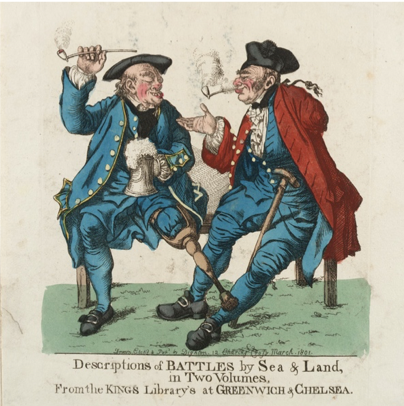
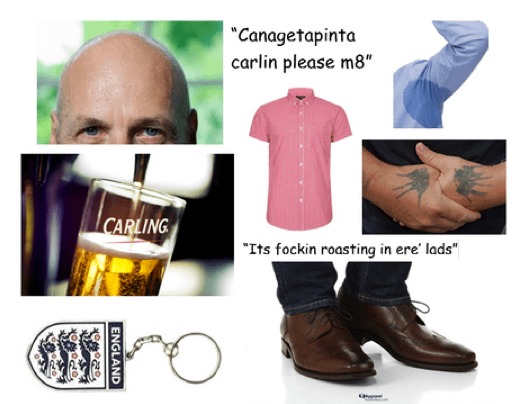
Any social role can be thinned out, can be brought ever closer to the Ideal Type of “LARPing.” Sure, I am a Christian, or a Communist, or a Totalitarian, but the way I live is indistinguishable from yours. My world is one where people – their clothing, accents, lifestyles, habits – are diverse and shallow. A world of the aesthetic wiki and the starter pack, where the variety of human forms is immense but transient, impermanent. Compare these caricatures:
The humour of both works in the same way: we recognise a “social type” and the previously-unseen pattern composing it. Yet how different their grammars are! The Georgian plate illustration depicts men with timeless, distinct ‘uniforms’, fundamental alterations to their bodies, and particular long-term habits. They are sailors and remain recognisably so. It is inconceivable that these two men, telling their tales of Battle, will lose this role; as they are now tells the story of a lifestyle which will always be a permanent part of their identity. The digital meme, on the other hand, depicts modular, disembodied signifiers: a tendency to sweat, an off-the-shelf shirt, a brand of shoes, unobtrusive tattoos, a preference for a kind of bitter. The “Middle-aged UK Pub Male” could reinvent himself completely, just as the image-editor could alter it. In so doing there would be no trace of his old identity. It would merely be a sweaty, Carling-soaked dream. Unlike the sailors, it is an ultra-specific, already dated image. But that does not matter. Both the subject and the audience are presumed to be impermanent.
The process of a social ‘thinning out’ first became noticeable in the early 1960s (although critiques of interchangeable city dwellers can be found in the 1930s and 1950s). It was criticised by 'progs' as a disempowering, socially enervating effect of capitalism:
The reign of such a one-dimensional reality does not mean that materialism rules, and that the spiritual, metaphysical, and bohemian occupations are petering out. On the contrary, there is a great deal of “Worship together this week,” “Why not try God,” Zen, existentialism, and beat ways of life, etc. But such modes of protest and transcendence are no longer contradictory to the status quo and no longer negative. They are rather the ceremonial part of practical behaviorism, its harmless negation, and are quickly digested by the status quo as part of its healthy diet.
(Marcuse, “The One-Dimensional Man.”)
Conversely, the 'trads' criticised the destruction of self-respect and character. Joan Didion in her earlier, more individualistic phase, recounted the following anecdote:
In a diary kept during the winter of 1846, an emigrating twelve-year-old named Narcissa Cornwall noted coolly: “Father was busy reading and did not notice that the house was being filled with strange Indians until Mother spoke about it.” Even lacking any clue as to what Mother said, one can scarcely fail to be impressed by the entire incident: the father reading, the Indians filing in, the mother choosing the words that would not alarm, the child duly recording the event and noting further that those particular Indians were not, “fortunately for us,” hostile. Indians were simply part of the donnée.
(Didion, “On Self Respect”, in Slouching Towards Bethlehem)
Although Didion speaks also of making one’s own moral code, or choosing one’s own life, it is clear she wants to live in a world populated by characters. By people who have committed to a social position, or role, or way of life, and through self-discipline thereby reproduce it. Do we want these kinds of characters in life? They represent a mixture of trauma, irreparable change, and social rigidity. In short, “social types” only exist in the shadow of non-optionality.
On the one hand I want to grasp these types with all my might, presumably with the force of the state. In fact, I want to become a social type: a teacher, local pillar of the community, father, son, and grandfather. On the other, I feel like letting go, allowing the centrifugal effects of modern technology, progressive capitalism, and liberal individualism spin me out into a fully independent agent. Things like community, villages, flags, uniforms, accents, national cuisine, local stereotypes, regional dialects, and old traditions can all vanish in the haze. Humanity produced its collective forms of culture between 12,000BC and 2025AD. After that it gave up and simply recycled from the existing library from now until eternity. And that’s okay because we live complete and perfect from moment to moment, making art, music, traditions, and life, even if it vanishes like the ripples in the sea.